RAD: A Realistic Multi-View Benchmark for Pose-Agnostic Anomaly Detection

Robot-captured inspection across unknown viewpoints, reflective materials, geometric symmetry, and four realistic defect types.

Authors and affiliations

Kaichen Zhou* Xinhai Chang* Taewhan Kim* Jiadong Zhang* Yang Cao Chufei Peng Fangneng Zhan Hao Zhao Hao Dong Kai Ming Ting Ye Zhu

Massachusetts Institute of Technology, Peking University, Carnegie Mellon University, Great Bay University, Harvard University, Tsinghua University, Nanjing University, Deakin University

* Equal contribution. † Corresponding author.

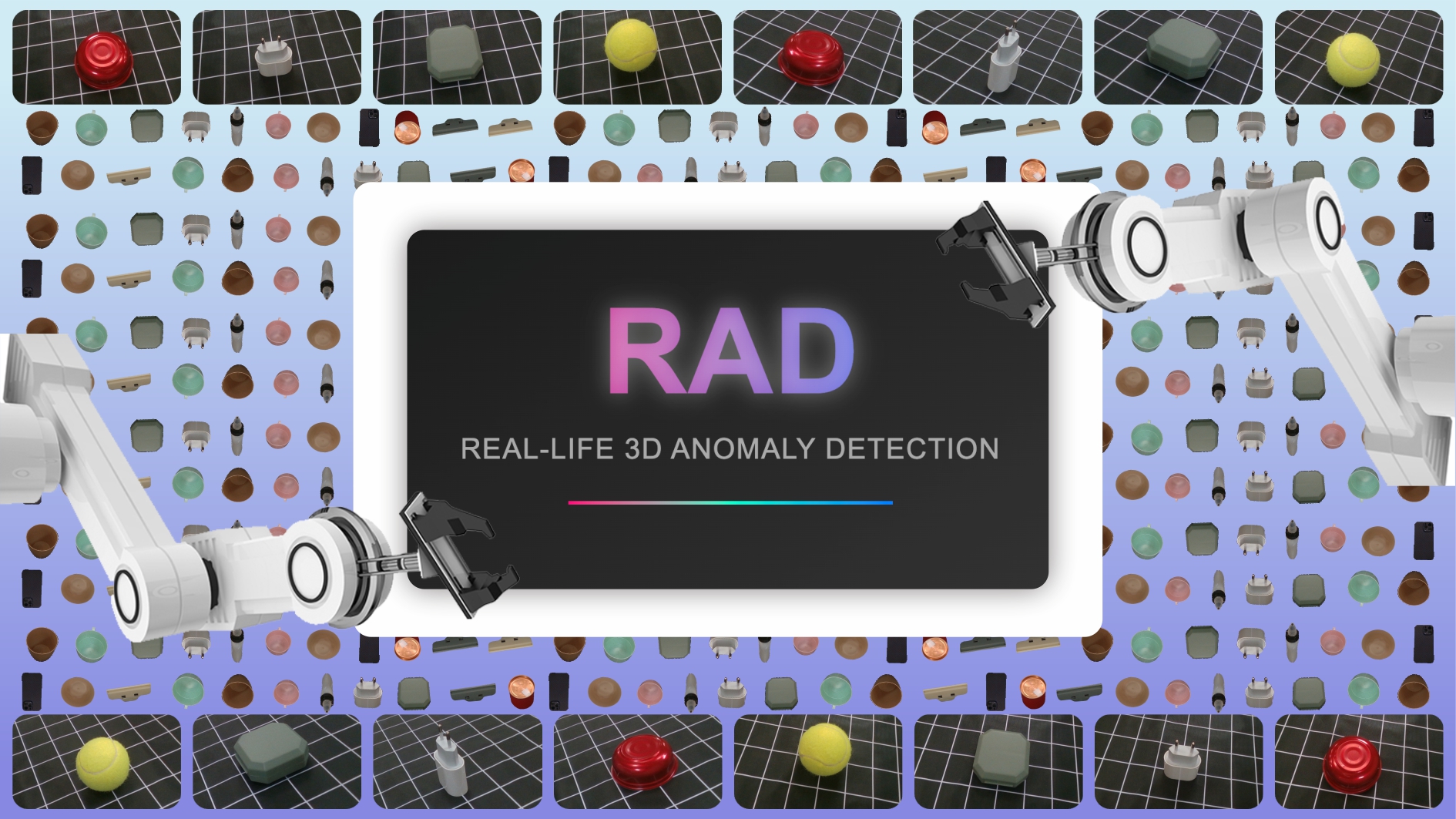
RAD gallery with thirteen industrial and everyday objects observed by a robot from multiple viewpoints
Thirteen categories captured from 68 robot viewpoints under uncontrolled illumination.

Inspection outside the lab

Anomaly detection is a core capability for robotic perception and industrial inspection, yet most existing benchmarks are collected under controlled conditions with fixed viewpoints and stable illumination, failing to reflect real deployment scenarios.

We introduce RAD (Realistic Anomaly Detection), a robot-captured, multi-view dataset designed to stress pose variation, reflective materials, and viewpoint-dependent defect visibility. RAD covers 13 everyday object categories and four realistic defect types: scratched, missing, stained, and squeezed. Each object is captured from 68 robot viewpoints under uncontrolled lighting.

We benchmark a wide range of state-of-the-art approaches, including 2D feature-based methods, 3D reconstruction pipelines, and vision-language models under a pose-agnostic setting. Mature 2D feature-embedding methods consistently outperform recent 3D and VLM-based approaches at the image level, while the gap narrows for pixel-level localization. Reflective surfaces, geometric symmetry, and sparse viewpoint coverage remain critical open problems.
4,287 RGB images 1,224 normal, 3,063 abnormal
13 object categories
68 robot viewpoints
4 defect types

A robot moves. The object stays.

Dense views expose appearance changes that fixed-camera datasets leave out.

RAD uses a Franka Emika Panda robotic arm with an Intel RealSense D415 RGB-D camera at 1280 × 720 resolution. The camera records each object from 68 predefined viewpoints spanning a full 360° rotation.

Capture
Single moving sensor
Release
RGB images and camera poses
Conditions
Uncontrolled illumination
Defects
Missing, stained, scratched, squeezed
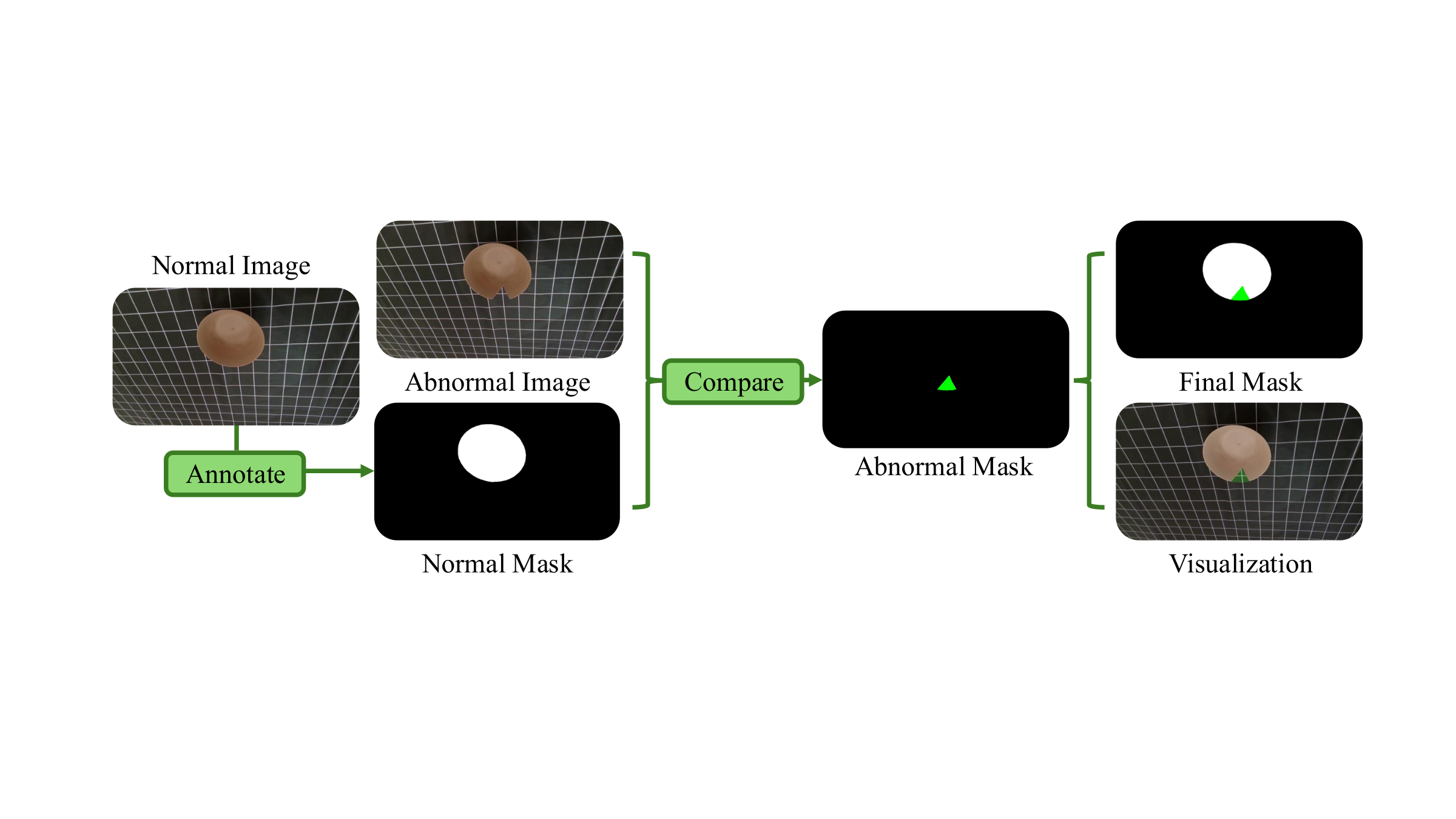
Annotation procedure comparing a defective object with normal references to identify missing components
Missing components are annotated by comparing defective images with corresponding normal views.
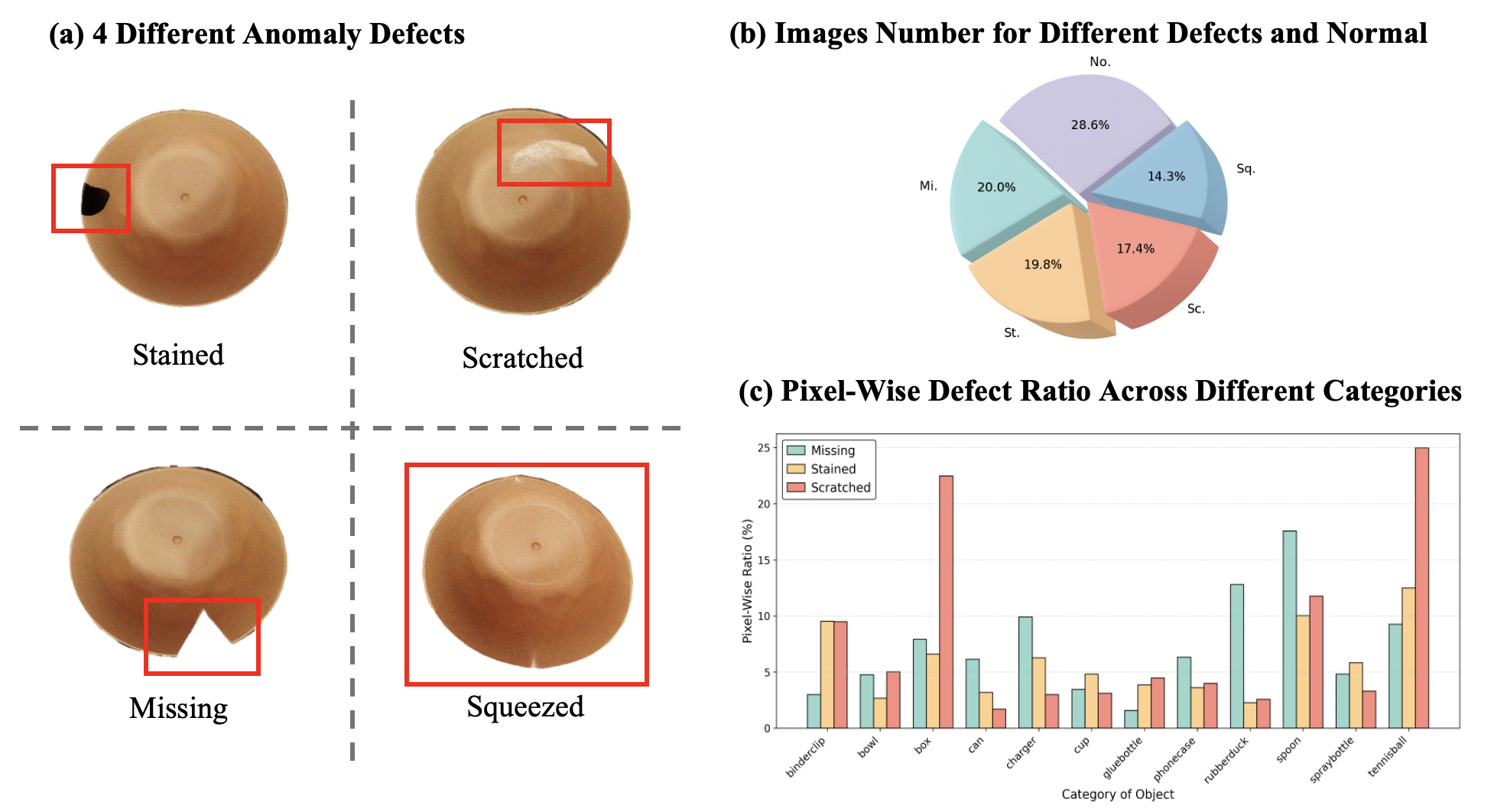
RAD statistics across object categories and missing, normal, squeezed, scratched, and stained samples
Category-level defect counts, overall defect distribution, and pixel-wise anomaly ratios.
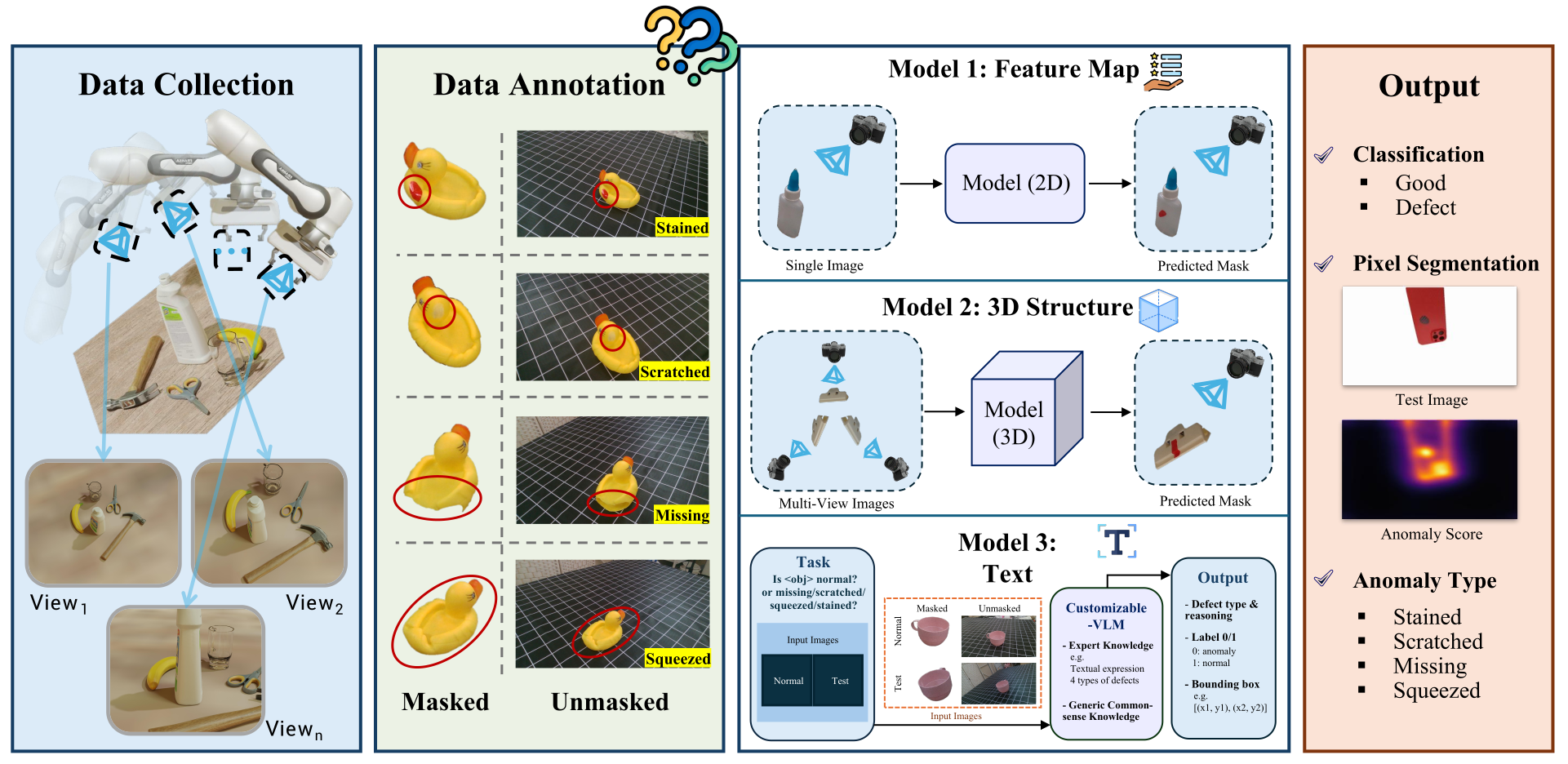
RAD benchmark pipeline from robotic data collection and annotation to 2D, 3D, and vision-language models
RAD connects robotic multi-view collection and fine-grained annotation to 2D, 3D, and VLM evaluation.

2D feature-based

Eight unsupervised methods plus three CLIP-based zero-shot variants, evaluated with standard Anomalib configurations where applicable.

  • CFlow
  • EfficientAD
  • FastFlow
  • PaDiM
  • PatchCore
  • Reverse Distillation
  • STFPM
  • UFlow
  • WinCLIP
  • AdaCLIP
  • VCP-CLIP

3D reconstruction

SplatPose and PIAD build object-centric 3D Gaussian Splatting representations using COLMAP-estimated camera poses.

Vision-language

Qwen2.5-VL and GPT-4o classify images, predict anomaly boxes, and convert boxes into masks for pixel evaluation.

2D leads detection. Localization is closer.

Reported mean AUROC from the v4 paper tables.

Image-level 0.833

PatchCore reports the highest mean image-level AUROC, followed by EfficientAD at 0.803.

Pixel-level 0.987

VCP-CLIP reports the highest mean pixel-level AUROC. CFlow, Reverse Distillation, and PIAD each report 0.984.

Representative mean AUROC on RAD
MethodFamilyImagePixel
PatchCoreFeature0.8330.978
EfficientADFeature0.8030.940
VCP-CLIPZero-shot0.6630.987
SplatPose3D0.5240.977
PIAD3D0.6340.984
Qwen2.5-VLVLM0.3050.538
GPT-4oVLM0.5170.517
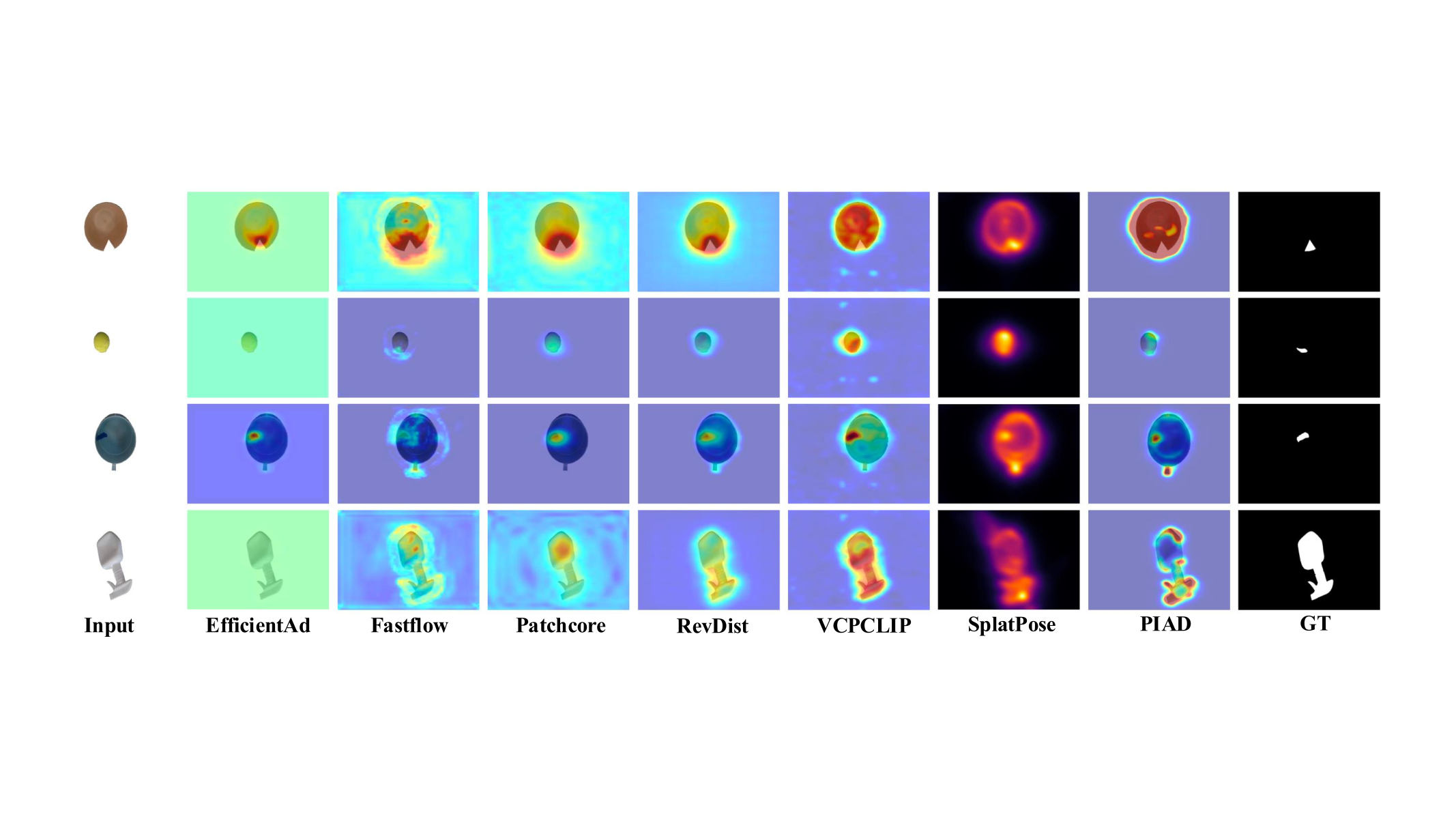
Pixel-wise anomaly localization results for Bowl and Spraybottle across multiple baseline methods
Ground truth and pixel-wise predictions for Bowl and Spraybottle across representative baselines.

Cite RAD

If RAD supports your research, cite the arXiv paper.

@misc{zhou2024rad,
  title   = {RAD: A Realistic Multi-View Benchmark for Pose-Agnostic Anomaly Detection},
  author  = {Zhou, Kaichen and Chang, Xinhai and Kim, Taewhan and Zhang, Jiadong and Cao, Yang and Peng, Chufei and Zhan, Fangneng and Zhao, Hao and Dong, Hao and Ting, Kai Ming and Zhu, Ye},
  year    = {2024},
  eprint  = {2410.00713},
  archivePrefix = {arXiv},
  primaryClass  = {cs.CV},
  doi     = {10.48550/arXiv.2410.00713},
  url     = {https://arxiv.org/abs/2410.00713}
}
Open DOI